
Urgent Notarized Copies of Documents in Kyiv and across Ukraine
Updated:
To have a copy certified, the original document must be presented to the notary. The notary makes the copy personally and then certifies it with their signature and seal. Notarized certification is possible only if the notary has personally examined the original, verified its validity, the correctness of its execution and the presence of all required details, and compared it with the copy or produced the copy themselves. The applicant also needs an identity document (passport).
We have worked with trusted notaries near Zoloti Vorota for more than ten years, so in most cases the copy is ready the same day. If you also need a translation with notarized certification, see our notarized translation in Kyiv service — both acts are completed in a single visit.
Cost: from UAH 300 per document (depends on the type of certification — see the price list below) Turnaround: from 2 hours Consultation: free of charge
Notarized copies of documents in Ukraine: general requirements
To obtain notarized certification you need the original document and your passport. Some documents may require additional signatures or copies of supporting documents.
For a notary to accept a document, it must meet several criteria:
- clear, legible text with no damage, corrections, or crossed-out words;
- the seals of the government bodies or other institutions that issued it, and bound, numbered pages if the document has more than one page.
Certification of the accuracy of copies is governed by Articles 75–78 of the Law of Ukraine “On Notaries”. The notary must confirm that the person requesting certification has the right to receive a copy of the document in question. A notarial act may be postponed if additional information needs to be requested or the document has to be sent for expert examination. Documents with erasures, added text, crossed-out words, or other unauthorized corrections — or written in pencil or fading ink — are not accepted; this is a Ministry of Justice requirement aimed at preventing fraud and forgery.
Cost of notarized copies: price list
| Service | Price | Ready in |
|---|---|---|
| Notarized copy of a document (up to 10 pages) | UAH 300 | from 2 hours |
| Certification of the translator’s signature, without certifying the copy | UAH 400 | from 2 hours |
| Translator’s signature + certified true copy (up to 10 pages) | UAH 400 | from 2 hours |
| Bilingual certification of the translator’s signature (and the copy, if needed) | UAH 400 | from 2 hours |
Prices are per document. For documents of more than 10 pages we confirm the cost within 15 minutes of seeing a scan. Discounts on notarized translation from 5 pages are listed on the prices page.
Notarized copy of a document — UAH 300
A notarized copy is a copy of the original bearing the notary’s signature, seal, and notarial inscription, which confirm that the copy matches the original. During certification the notary examines the original, compares it with the copy, and binds and seals it. It is also possible to certify a copy of a copy, provided that copy was itself notarized or issued by the legal entity that issued the original.
The documents most often certified are educational documents, employment record books, birth certificates, powers of attorney, licenses, and corporate documents.
Certification of the translator’s signature, without the copy — UAH 400
To give a translation official status it must be notarized. The notary verifies the translator’s diploma and certifies their signature on the document. The translation is attached to the original or a copy of the document, and the notarial inscription is placed on the back of the last page. The document is bound and bears the signatures of the translator and the notary and the official seal.
This certification is required for official use of the translation in Ukraine: in court, when obtaining a residence permit, a tax number, or other documents for foreigners, and when concluding sale contracts, powers of attorney, and applications. For submission abroad the requirements vary by country and institution, so check them in advance.
Translator’s signature together with a certified copy — UAH 400
Here, along with the translator’s signature, the notary also certifies that the copy is a true copy, so the original must be presented. The procedure involves two checks: the authenticity of the translator’s signature and the accuracy of the copy compared with the original.
This option is needed when the translation is bound to a copy rather than the original, and the receiving institution specifically requires a notarized copy. For example, if you have a single power of attorney in Polish covering the sale of several properties, it is translated into Ukrainian and the translation is certified and bound to a notarized copy: the registrar keeps the copy with the translation for their archive, while the original stays with you.
Bilingual certification of the translator’s signature — UAH 400
The notary certifies the translator’s signature and, if needed, the copy, and the certification text is written in Ukrainian and duplicated in the target language. We recommend this option when the translation is intended for submission abroad: the notarial inscription will be readable by the foreign institution. The wording of the inscription is set by the Ministry of Justice of Ukraine — the Ukrainian text is mandatory, and the duplication in the target language is added at the client’s request.
How a copy is certified by a notary: step by step
- Prepare the original and a passport. A notary will not certify a copy made from a photocopy, photo, or scan — the original is required. A multi-page document must be bound and numbered.
- The notary examines the original. Validity, details, seals, absence of corrections. If the document does not meet the requirements, the notary refuses certification — which is why we recommend sending us a scan first.
- The notary makes the copy. Copies you bring with you are not used: the notary makes the copy personally to rule out page substitution.
- Binding, inscription, seal. The pages of the copy are bound, a true-copy note is placed on each page or on the last one, and the end of the document bears the notarial inscription, the notary’s signature, and the seal.
- Registration in the register. The notarial act receives a number in the register of notarial acts, by which any institution can verify that the certification is genuine.
At MovaPro you simply bring the original to our office at 9 Yaroslaviv Val or send it with a trusted person — our manager takes the document to the notary. You can place an order online, and we ship finished documents by Nova Poshta across Ukraine and by DHL worldwide.
What a notarized copy looks like: the notarial inscription
A certified copy carries two elements. The first is the true-copy note («Згідно з оригіналом» — “true to the original”), which the notary applies with a stamp or by hand. The second is the notarial inscription on the last page. Its form is set by the Rules of Notarial Record-Keeping approved by the Ministry of Justice; the standard wording, in English translation, reads:
City of Kyiv, Ukraine. [Date in words]. I, [full name], private notary of the Kyiv City Notarial District, certify that this copy is a true copy of the original document; the latter contains no erasures, additions, crossed-out words, unauthorized corrections, or other irregularities. Registered in the register under No. ___. Fee charged: ___. Private notary — signature, seal.
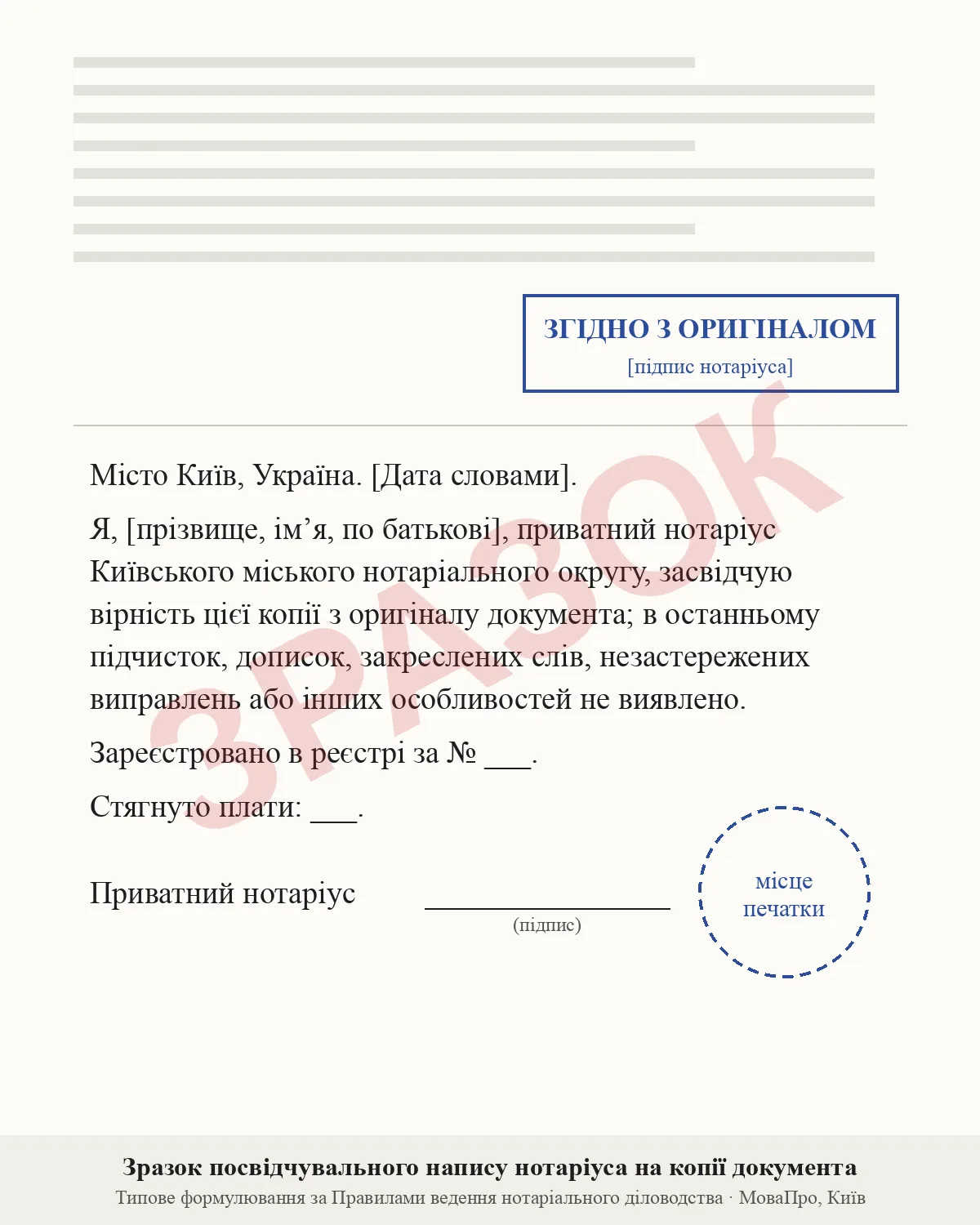
If the copy has several pages, the sheets are bound with thread, numbered, and the ends of the thread on the back of the last sheet are sealed with a paper label bearing the notary’s seal and the number of sheets. These are the features by which an institution distinguishes a notarized copy from an ordinary photocopy.
A certified passport copy has its own particulars: the notary copies every completed page (for an ID card — both sides and, if required, the register extract), and the passport holder is normally expected to be present, because the notary is verifying the validity of that person’s document.
”True copy” without a notary: when a company’s own certification is enough
Not every copy has to go to a notary. An enterprise, institution, or organization may certify a copy of a document it issued or whose original it holds — for instance, an employer certifies a copy of an order or an employment record book for an employee. The procedure is set by the national standard DSTU 4163:2020 “Unified system of organizational and administrative documentation. Requirements for the execution of documents”, in force since 1 September 2021. The certification note consists of:
- the words «Згідно з оригіналом» (“true to the original”; the older wording «Копія вірна» is outdated but still accepted by most institutions);
- the position of the person certifying the copy;
- their personal signature, initials, and surname;
- the date of certification;
- the organization’s seal, if it uses one.
Such certification does not replace notarization where an institution expressly requires a “notarized copy”: passports, civil registry certificates, diplomas, corporate documents, and documents for banks, embassies, or foreign authorities require a notary.
Who has the right to certify copies of documents
Article 75 of the Law of Ukraine “On Notaries” classifies certification of copies of documents and extracts from them as a notarial act. It may be performed by:
- private and state notaries — for any document that has legal significance and does not contradict the law;
- authorized officials of local self-government bodies — in localities with no notary;
- Ukrainian consular offices abroad — for citizens who are in another country;
- organizations — only for documents they issued themselves or whose originals they hold (see the previous section).
A notary will not certify copies of documents that contradict the law or defame a person’s honor and dignity, or documents with unauthorized corrections. If only part of a document needs to be confirmed, the notary certifies an extract — the required passage in its original form.
Copies of documents for court
The procedural codes in force since late 2017 set a single rule: documents are submitted to court either as originals or as duly certified copies (Article 95 of the Civil Procedure Code, Article 94 of the Code of Administrative Procedure, Article 91 of the Commercial Procedure Code; similar rules apply in criminal proceedings). A party submitting a copy states that the original is held by them or by another person and certifies the copy with their own signature and the date. The court may demand the original if the copy raises doubt or the other party requests it.
So for your own documents in court, self-certification under the DSTU rules is sufficient. A notarized copy is needed when the original cannot be handed over (passport, diploma, title documents) or when the same document is filed in several cases at once.
Which documents a notary can certify — and which not
A notary certifies copies of documents for personal, educational, legal, and commercial purposes:
- personal and family: passports, diplomas and school certificates, employment record books, birth, marriage, divorce, and death certificates;
- legal: sale and lease contracts, powers of attorney, licenses and certificates, charters and founding agreements, minutes;
- state and military: military IDs, court decisions, certificates of no criminal record, pension certificates;
- identification and registration: driving licenses, vehicle registration documents;
- commercial and financial: financial statements, audit reports, bank guarantees and letters of credit;
- medical and educational: medical reports, academic transcripts, research papers.
Copies cannot be certified for documents written in pencil, with erasures or unauthorized corrections, documents lacking the signatures and seals they should bear, or copies made from uncertified copies. Foreign documents are certified only after legalization or an apostille — usually together with a notarized translation.
How long a notarized copy is valid and what force it has
Once certified, the copy has the same legal force as the original and can be used for the same purposes. It has no expiry of its own — it remains valid for as long as the original does. The exception is documents with a limited validity period (a certificate of no criminal record, medical certificates): the copy “ages” together with them. You can have several copies certified in one visit and use them at different times — cheaper and faster than returning to the notary each time.
How to order notarized copies from MovaPro
Our office is in the center of Kyiv at 9 Yaroslaviv Val, 4th floor, office 405, two minutes from Zoloti Vorota metro station. Bring the original during working hours or send a scan in advance — we will check whether the notary will accept the document and quote the exact cost within 15 minutes. For clients in other cities and abroad, finished documents are shipped by Nova Poshta and DHL; note that for a certified copy the original still has to reach the notary — a trusted person can deliver it.
Alongside certified copies we provide notarized translation, apostille services, and translation of personal documents — all in one office, with no separate trips to the notary or the ministries.
Frequently asked questions
How much does it cost to notarize a copy of a document in Ukraine?
Notarized certification of a copy of a document of up to 10 pages costs UAH 300. Certification of the translator's signature costs UAH 400; the translator's signature together with certification of the copy — UAH 400; bilingual certification — UAH 400 per document. Ready from 2 hours.
How much does a notarized copy of a passport cost?
A notarized copy of a passport costs UAH 300. The notary copies all the pages personally, binds them, and places the notarial inscription on the last page.
Can a notary certify a copy without seeing the original?
No. A notary certifies a copy only after personally examining the original. The one exception is a copy of a copy, if that copy was itself notarized or issued by the body that issued the original.
Do I have to be present at the notary in person?
For a certified copy it is enough that a trusted person — a relative or our manager — brings the original and the applicant's passport. Your presence is required only for acts in which the notary certifies your signature or your will (powers of attorney, statements).
How many copies can I have certified in one visit?
As many as you need — each copy is certified and paid for separately. We recommend making 2–3 copies straight away for documents that will be submitted to several institutions, so you do not have to return to the notary.
Does a notarized copy have the same legal force as the original?
Yes. A notarized copy has the same legal force as the original and is valid for as long as the original itself. An institution may not demand the original where the law allows a certified copy to be submitted.
Can a foreign document be certified?
Yes, provided it has been legalized or apostilled (for Hague Convention countries) and does not contradict Ukrainian law. A notarized translation is usually ordered together with the copy — we do both in a single visit.
Need a translation? Send your documents — quote in 15 minutes
A photo or scan by messenger or email. Discount on 5+ pages.